
Product Introduction
Application case
Inlay for Electric Toothbrush Handle Mold: The product yield has been significantly improved, and the injection molding cooling time has been reduced by 25%. |  | |
Electronic Cigarette Mold Inserts: Addressing the challenge of low yield in conventional water circuits, the injection molding cooling time is concurrently reduced by 35%. |  | |
Automotive Emblem Die Insert: Solve the problem of trapped air during the second injection molding of two-color molds, effectively improving the yield of qualified products. |  | |
Mold inserts for the roller of a floor sweeping robot: Uniform airflow distribution through ventilation zones facilitates product levitation above the mold core, effectively addressing demolding challenges associated with TPU materials. |  | |
Ventilated Thimble: This solution effectively addresses the exhaust requirements in specialized regions of the mold. |  | |
 |  |  |
| Mold Insert | Mold Insert | Die-casting Mold |
 |  |  |
| lampshade | Coffee Cup Lid Mold | Conformal Cooling Insert for Bottle Mold Neck Thread Section |
Industry Profile
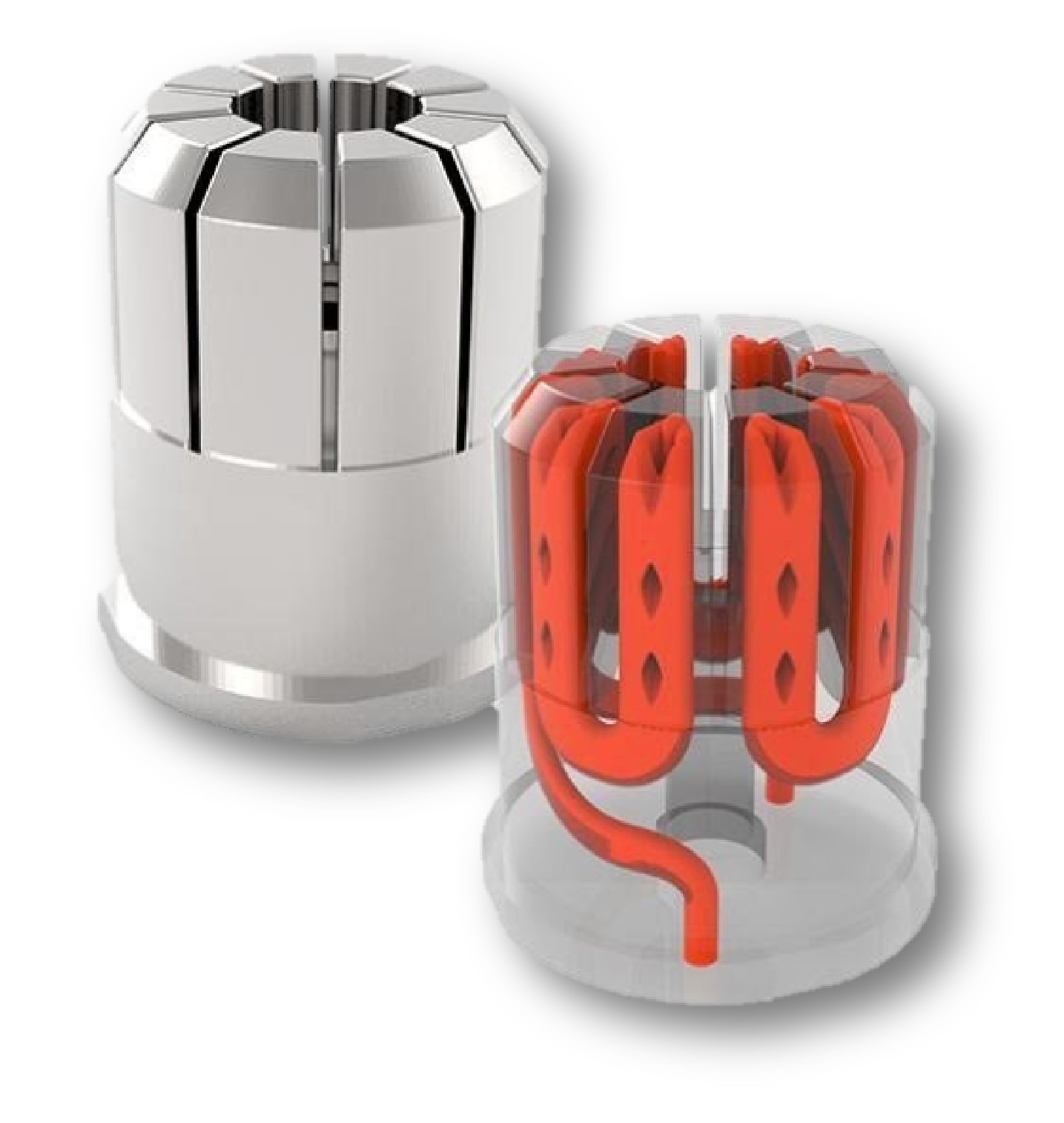
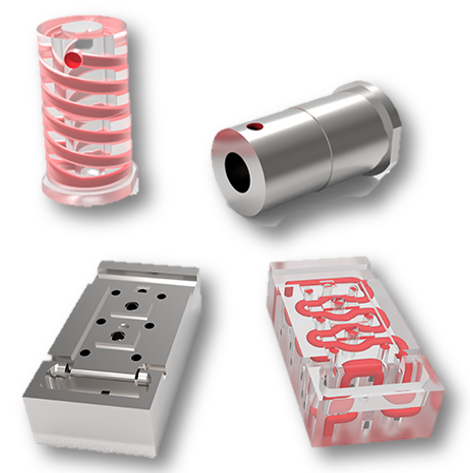
Conventional techniques for fabricating molds with cooling channels typically produce straight-flow channels, resulting in slow and non-uniform cooling efficiency. In contrast, metal additive manufacturing enables the production of molds with conformal cooling channels featuring intricate geometries. Compared to traditional molds, conformal cooling channel molds facilitate rapid and even heat dissipation during operation, leading to faster and more efficient demolding. Moreover, metal 3D printing allows for the integration of venting holes in mold products—a capability beyond the reach of traditional manufacturing methods. The application of metal additive manufacturing technology affords greater design freedom and flexibility in mold development, thereby advancing the trend toward customized and complex mold production. Ultimately, it accelerates the evolution of the mold industry toward rapid manufacturing.
Advantages of Metal Additive Manufacturing
1. The direct printing of molds with conformal cooling channels significantly increases the heat dissipation area during product molding, thereby enhancing cooling efficiency and boosting production efficiency by over 35%.
2. Conformal cooling ensures a uniform temperature distribution across the mold, effectively preventing product defects such as warping, cracking, flash, as well as air bubbles and sand holes.
3. Metal additive manufacturing enables design freedom, reduces manual intervention, and substantially shortens the mold fabrication cycle, ultimately lowering manufacturing costs across multiple stages.
2. Conformal cooling ensures a uniform temperature distribution across the mold, effectively preventing product defects such as warping, cracking, flash, as well as air bubbles and sand holes.
3. Metal additive manufacturing enables design freedom, reduces manual intervention, and substantially shortens the mold fabrication cycle, ultimately lowering manufacturing costs across multiple stages.
The working principle of SLM metal 3D printing
Using metal powder as raw material, the 3D model data is sliced in the Z direction into two-dimensional planar graphics. The two-dimensional planar graphics are sintered and formed on the powder bed by controlling the laser path with a galvanometer, and then the two-dimensional graphics are stacked to form a three-dimensional part.

SLM Metal 3D Printing Materials and Properties(as-heat-treated condition)
| Material type | Material designation | Tensile Strength / MPa | Yield Strength/MPa | Ductility/% | ||
| X-axis and Y-axis direction | Z-axis direction | X-axis and Y-axis direction | Z-axis direction | |||
| Aluminium alloy | AlSi10Mg | 456±30 | 440±30 | 311±30 | 270±30 | 8±2 |
| AlSi7Mg | 424±20 | 405±20 | 289±20 | 262±20 | ≥7 | |
| aldural | 541±15 | 515±15 | 520±15 | 475±30 | ≥10 | |
| Titanium alloy | TC4 | 1040±90 | 1050±90 | 980±90 | 1000±90 | 14±4 |
| TA15 | 1118±100 | 1142±100 | 1064±100 | 1118±100 | 12±4 | |
| Stainless steel | 316L | 678±20 | 650±20 | 427±30 | 418±30 | 51±10 |
| 304L | 600±50 | 597±50 | 353±20 | 352±20 | 55±10 | |
| 4J36 | 550±50 | 530±50 | 492±50 | 472±50 | 34 | |
| 17-4PH | 1110±50 | 1109±50 | 1073±50 | 1046±50 | ≥15 | |
| Die steel | MS1(1.2709/18Ni300) | 1833±50 | 1805±50 | 1772±50 | 1739±50 | ≥7 |
| High temperature alloy | GH4169(In718) | 1400±50 | 1250±50 | 1250±50 | 1250±50 | 9~20 |
| GH3625 | 900±50 | 850±50 | 410±50 | 390±50 | ||
| GH5188 | 954±20 | 888±20 | 449±20 | 441±20 | 64±10 | |
| GH3536 | 878±50 | 885±50 | 548±30 | 549±30 | 37±10 | |
| GH4099 | 1215±50 | 1170±50 | 1047±50 | 988±50 | 30±5 | |
模具生产效率问题