
Product Introduction
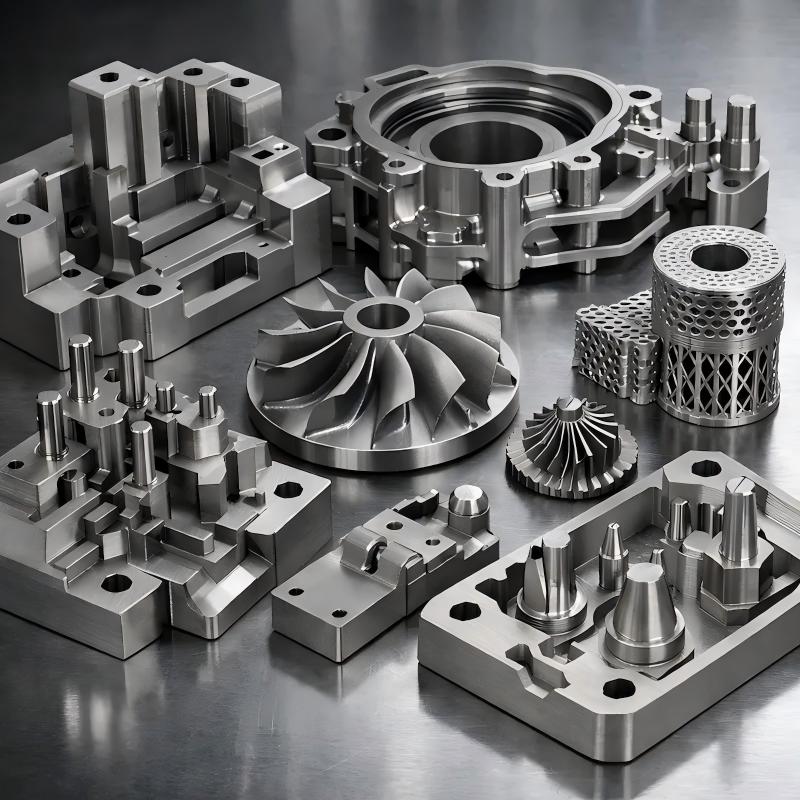
Mold steel 3D printing 1.2709(SLM)
| Tool steel 1.2709 is one of the commonly used die steel systems in metal 3D printing for applications such as jigs/fixtures, mold inserts, and high-strength structural components. When higher mechanical strength and potential for subsequent heat treatment are required, along with the need to implement complex cooling channels, integrated structures, or internal functional features via Selective Laser Melting (SLM), this material system typically enables significant shortening of the development cycle. It also accommodates subsequent heat treatment and finishing processes, thereby achieving higher hardness and improved assembly precision. |
Key parameters and order requirements
| Prior to placing an order, please confirm the following: ① Whether heat treatment/aging or designated material conditions are required (affecting strength, dimensional accuracy, and machining strategy); ② Whether there are critical mating surfaces, sealing interfaces, or locating holes (it is recommended to provide 2D annotations and datum definitions); ③ Whether internal flow channels or conformal cooling features are included (minimal channel diameter, powder removal, and plugging requirements should be specified); ④ Whether threading, secondary precision machining, or assembly references are needed (this will impact machining allowances and delivery schedules). Standard engineering parameters are provided for reference; however, the final performance and dimensional characteristics are influenced by the SLM build orientation, heat treatment route, and subsequent machining processes. If specific requirements for assembly precision, hardness, or surface condition are critical, please clearly specify the "critical surfaces/critical holes/critical tolerances/post-processing and machining requirements" in the remarks section to facilitate engineering evaluation and quotation. |
| Technology | Selective Laser Melting (SLM) 3D Printing (Maraging Steel 1.2709) |
| Layer thickness | 30–50 μm (standard, subject to equipment configuration and specific parameter sets) |
| Dimensional tolerance | ±0.1 mm (Standard Reference; For critical dimensions, compliance with 2D notation/tolerance specifications is recommended) |
| Minimum wall thickness | A minimum thickness of 0.5 mm is recommended; however, for thin-walled structures or long overhangs, rib reinforcement or optimized support strategies are advised due to constraints imposed by structural geometry and build orientation |
| Minimum Aperture/Diameter | It is recommended that the diameter of formed holes/channels be ≥2.0–3.0 mm. The internal flow paths should incorporate design considerations for powder clearance routes and necessary cleaning apertures |
| Text / Texture | The height of embossed characters shall be no less than 0.4–0.6 mm; the depth of recessed characters shall be no less than 0.3–0.5 mm; and the line width shall be no less than 0.35–0.50mm |
| Tensile strength | 1000–1400 MPa (reference range; condition dependent on heat treatment status) |
| Temperature resistance | 400°C (reference) |
| Density | Approximately 8 g/cm³ |
| Surface roughness | SLM-fabricated surfaces typically exhibit inherent roughness; critical interfaces can be enhanced in both aesthetics and fit through sandblasting followed by finishing processes |
| Recommended Use | Jigs and fixtures, mold inserts, and high-strength structural components; suitable for intricate cooling channels and integrated structural designs |
| Assembly and Machining | Common Practice: Machining allowance to be reserved at key hole positions/fitting surfaces. Threaded tapping (specifying thread type and quantity) is recommended when threaded connections are required |
| postprocessing | Sandblasting, CNC machining (thread tapping), painting, polishing, electroplating, passivation, anodizing, laser engraving, screen printing |
| Standard Delivery Lead Time | The delivery timeline depends on factors including dimensions, quantity, structural complexity, presence of internal flow channels, and subsequent processing requirements. Upon file upload, a definitive delivery date and expedited options will be provided |
postprocessing
| Sandblasting (For Surface Uniformity Enhancement) | Tapping (Thread Assembly) |
| This process enhances the surface texture and consistency of metal-printed components while mitigating the granular texture characteristic of powder sintering. The intensity of blasting and the masking of critical surfaces can be customized according to specific aesthetic requirements. | For threaded assembly and positioning connections; please specify the thread specifications (e.g., M3/M4/M6), quantity, and hole location requirements in the remarks. For critical holes, it is recommended to also provide 2D annotations. |
Why Mold steel 3D printing 1.2709(SLM)
| High-Intensity Pathways for Mold/Jig Manufacturing | Complex Cooling Channels and Integrated Structures | Integration Space of Heat Treatment and Precision Machining | Ordering engineering collaboration is more controllable |
| More suitable for fixtures, mold inserts, and load-bearing structural components; balances strength with post-processing flexibility, with a clear engineering application orientation | SLM enables the fabrication of internal flow channels and conformal cooling structures that are challenging to achieve through conventional manufacturing, thereby shortening development cycles and enhancing design flexibility | Subsequent heat treatment and precision machining processes can enhance hardness, assembly accuracy, and surface quality of critical areas, making them suitable for projects with stringent fitting requirements | By defining critical surfaces, specifying geometric dimensioning and tolerancing with datums, and clarifying threading requirements, it is possible to predefine risks and delivery standards more effectively during the quotation phase |
More suitable (recommended) | Direct application is not recommended (process/material alteration advised) |
|
|
Design and DFM Recommendations
Critical Surfaces and Machining Allowances: It is recommended to reserve machining allowances for mating/sealing surfaces and locating holes, with datums and tolerances clearly specified in 2D drawings, to preclude the direct use of as-printed conditions as assembly interfaces. |
Internal Flow Channels / Conformal Cooling: Reserve passages and apertures for powder cleaning. Extended enclosed sections and sharp-angle dead ends in the channel should be minimized; segmented design or the addition of temporarily sealable structures may be implemented where necessary. |
Slender-Walled Structures and Long Overhangs: A thickness of 1.0 mm or greater is recommended as an initial guideline. For thin-walled components and structures with long cantilever sections, the incorporation of ribs and fillet transitions is advised to minimize deformation and mitigate stress concentration risks. |
| Threads and Mounting Holes: Recommended procedure: perform tapping operations with explicit specifications for thread type, hole depth, and quantity; for critical holes, provide 2D annotations with the note “assembly hole accuracy takes precedence.” |
Surface and Appearance Standards: Sandblasting improves consistency; however, precision finishing is still recommended for critical surfaces. If certain surfaces require masking, such as sealing, locating, or mating faces, please specify this in the remarks. |
Compared with common metal 3D printing materials
| materials | core advantage | Mainly applicable | Not Applicable |
| Stainless Steel 316L (SLM) | Enhanced corrosion resistance, suitable for application in humid/saline environments and compatibility with general metal terminal components | Corrosion-Resistant Functional Components, End Parts, and Complex Structural Components | For projects where lightweight design and thermal conductivity are the primary objectives (AlSi10Mg is more suitable) |
Aluminum alloy AlSi10Mg (SLM) | Enhanced lightweight design, ideal for integrated molding of thermal dissipation/conductivity and complex structures | Heat Sinks, Lightweight Supports/Brackets, and Complex-Flow-Channel Metallic Components | Scenario Prioritizing High Corrosion Resistance (316L Offers Superior Stability) |
Titanium alloy TC4 (SLM) | High strength-to-weight ratio, performance first | High-end structural components, lightweight terminal parts, reliability-prioritized parts | Budget-sensitive general lightweight / heat dissipation parts (AlSi10Mg is more economical) |
Nickel-based superalloy (SLM) | It has strong heat resistance and is suitable for high-temperature working conditions | High-temperature functional parts, thermal environment verification parts | Only corrosion resistance / general strength requirements (316L is more balanced) |