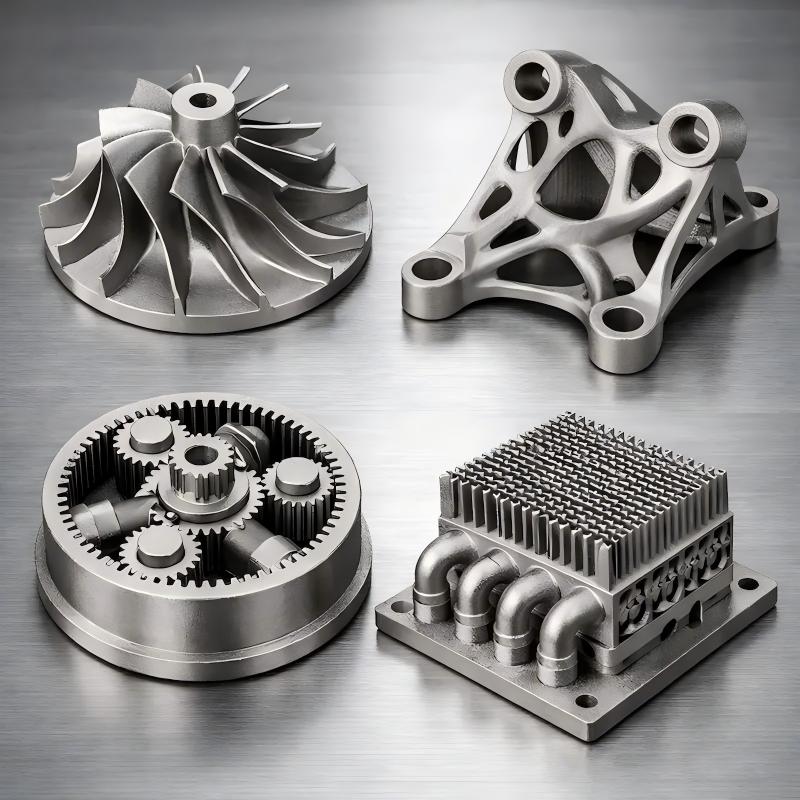

Product Introduction
Stainless steel 316L (SLM)
| Stainless steel 316L is a widely adopted corrosion-resistant alloy in metal additive manufacturing, specifically in selective laser melting (SLM) processes. It serves as an optimal solution when components require high strength, corrosion resistance, and functional end-use applicability, while also leveraging the advantages of metal additive manufacturing to achieve integrated complex geometries, internal cooling channels, and reduced assembly needs. The 316L material offers a balanced combination of mechanical performance and manufacturability, making it a preferred choice in such applications. |
Key parameters and order requirements
| Prior to placing an order, please confirm the following requirements: ① Whether corrosion resistance (for humid/salt spray/chemical environments) and environmental usage specifications are needed; ② Whether key dimensions such as sealing surfaces/assembly datums/fitting holes are present (2D annotations are recommended); ③ Whether complex internal cavities/flow channels exist (ensuring adequate powder removal and cleaning paths); ④ Whether threaded tapping/assembly hole quality is required (affecting secondary processing and delivery time). Standard Specification Range: Accuracy ±0.1 mm, Minimum Wall Thickness 0.5 mm, Heat Resistance up to 400°C, Tensile Strength 480–650 MPa, Density 7.9 g/cm³. Actual values may vary depending on equipment configuration, part orientation, support strategy, and post-processing treatments. |
| technology | SLM Metal 3D Printing (Stainless Steel 316L) |
| Material Positioning | Corrosion-resistant metal functional components / terminal parts; suitable for complex structures, integrated designs, and internal flow channel parts |
| Size Tolerance (Reference) | ±0.1 (Common range; critical holes/baselines are recommended for secondary processing or note "priority on accuracy") |
| Minimum Wall Thickness (Reference) | ≥0.5 mm (Thin walls/long cantilevers require assessment of support and deformation control) |
| Temperature Resistance (Reference) | 400℃ |
| Tensile Strength (Reference) | 480–650 MPa |
| Density (Reference) | 7.9 g/cm³ |
| Assembly Holes and Threads | It is recommended to perform secondary processing (reaming/honing) on assembly holes/positioning holes to ensure fit; Threads are recommended to be obtained through tapping for more stable assembly quality (please specify M specification, quantity and position) |
| Post-processing | Sandblasting, CNC machining (thread tapping), painting, polishing, electroplating, passivation, anodizing, laser engraving, screen printing |
| Typical Delivery Time | Related to the complexity of the structure, quantity, support and post-processing; Provide clear delivery time and rush option after uploading files |
postprocessing
| Sandblasting (Surface Uniformity and Feel) | Drilling (for reliable assembly) |
| Used to improve the uniformity of the surface of metal 3D printing, reduce the difference in reflection, and make the appearance more "industrial consistent". For the surface to be sprayed, the sandblasting grade/fineness preference can be noted. | Used to achieve a more stable threaded assembly quality. Please mark the thread specifications (such as M3/M4/M6), hole position reference and quantity in the remarks. |
Why choose stainless steel 316L (for metal 3D printing)
| More corrosion-resistant and more stable | Solid in strength | Integrated one-piece molding of complex structure | Can be combined with post-processing and refinement |
| It is more stable in humid, salt-spray and some chemical medium environments, and is suitable for metal terminal components that require long-term reliability. | Suitable for load-bearing structural components and functional parts; for the parts that are sensitive to assembly accuracy, secondary processing can be carried out to further improve the quality | It is more suitable for the internal structures and special flow channels of difficult-to-machine parts in traditional CNC, as well as for the assembly design of reduced components, thereby enhancing the integration degree. | Support for post-processing such as sandblasting and tapping; key holes/sealed surfaces can have machining paths planned to meet assembly and sealing requirements. |
More suitable (recommended) | It is not recommended to simply use (suggestion: change the plan) |
|
|
Design and DFM Recommendations
The inner cavity/flow channel must be capable of discharging powder: Try to provide discharge holes and cleaning paths to avoid completely sealing the cavity; for complex channels, it is recommended to conduct DFM review first. |
The key holes/cooperative surfaces are recommended for secondary processing: Printing is more suitable for "forming complex shapes", and the key assembly surfaces can be made more stable through fine processing. |
Thin walls and long cantilevers: A thickness of ≥ 0.5mm is the reference lower limit; thin walls/elongated structures are more dependent on support and placement, and it is recommended to add reinforcement/round corners/shorten the cantilever. |
| Thread priority tapping: For threaded holes with high requirements for assembly reliability, it is recommended to perform tapping. Please note the thread specifications and quantities. |
It is necessary to clearly state in advance: Sandblasting can improve consistency, but roughening should be avoided on the sealing surface / sliding mating surface. It is recommended to mark the appearance surface and the functional surface. |
Compared with common metal 3D printing materials
| materials | core advantage | Mainly applicable | Not Applicable |
| Aluminum alloy AlSi10Mg (SLM) | Lightweight design is more robust, suitable for integrated molding of heat dissipation/thermal conductivity and complex structures | Heat sink, lightweight bracket, complex flow channel metal parts | High corrosion resistance priority scenario (316L is more stable) |
| Titanium alloy TC4 (SLM) | High strength-to-weight ratio, corrosion-resistant, performance-oriented | High-end structural components, lightweight terminal parts, and reliability-prioritized parts | Budget-sensitive, general corrosion-resistant requirements (316L is more cost-effective) |
| Mold steel 1.2709 (SLM) | High strength and good heat treatment performance, suitable for jigs/molds type applications | Jigs, fixtures, mold inserts, high-strength structural components | High corrosion resistance requirements (316L is more suitable) |
| Nickel-based superalloy (SLM) | High temperature resistance, suitable for high-temperature working conditions | High-temperature functional components, thermal environment verification documents | Only corrosion resistance / general strength requirements (316L offers a more balanced solution) |