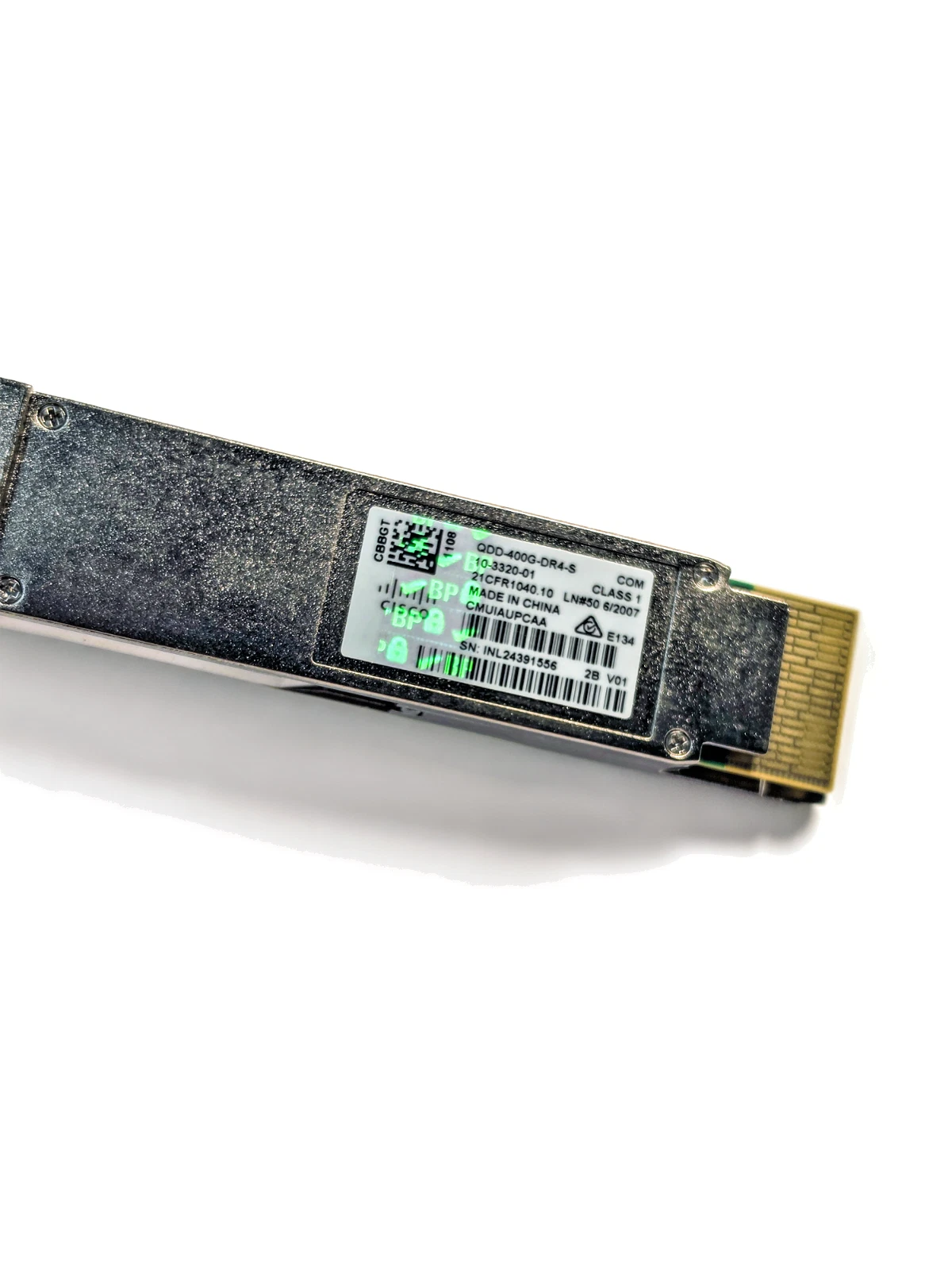


The Cisco QDD-400G-DR4-S Module supports link lengths of up to 500m SMF with duplex MOP-12 connector. It is compliant to IEEE 802.3cu requirements but extends the reach to 500m, is compliant to100G Lambda MSA group 400G-DR4 requirements, and 400GAUI-8/CEI-56G-VSR-PAM4 standards. The 400 Gigabit Ethernet signal is carried over four CWDM grid optical wavelengths. Multiplexing and demultiplexing of the four wavelengths are managed within the device. FEC is performed on the host platform.
| Property | Value |
|---|---|
| Model | QDD-400G-DR4-S |
| Connector | MPO-12 |
| DOM | DOM |
| Form Type | QSFP-DD |
| Media | SMF |
| Reach | 500m |
| Speed | 400GBase |
| Speed Description | 400-Gigabit |
| Transceiver Type | DR4 |
| Wavelength | 1310nm |
| Environment | 0 to 70°C |
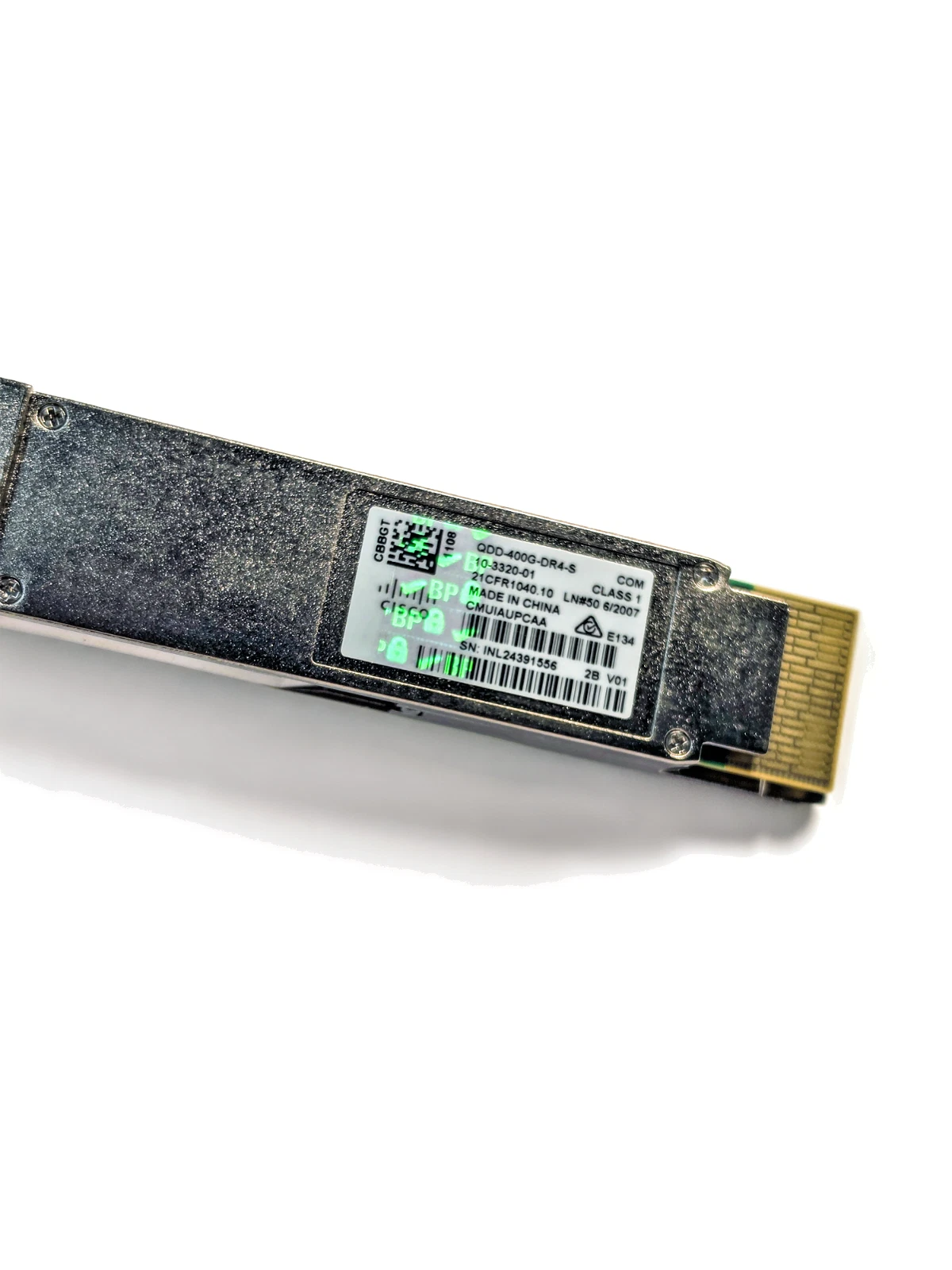
Q1: What are the primary applications and distance limitations for the Cisco QDD-400G-DR4-S optical module?
A: The Cisco QDD-400G-DR4-S is an enterprise-grade, high-density 400G optical transceiver engineered specifically for hyperscale data centers, cloud computing backbones, and large-scale enterprise core architectures.
Media and Reach: It is designed to transmit data over Single-Mode Fiber (SMF) up to a maximum physical link length of 500 meters (500m).
Primary Use Case: It serves as the ideal cost-optimized solution for short-reach single-mode optical links, such as Spine-to-Leaf switch interconnects and high-capacity Top-of-Rack (ToR) switch-to-server aggregation paths within modern data center halls.
Q2: Why does the QDD-400G-DR4-S use an MPO-12 optical connector instead of a standard Duplex LC interface?
A: This is dictated by the transceiver's underlying optical lane architecture:
Parallel Optics Design: The QDD-400G-DR4-S operates using parallel optics rather than multiplexed wavelengths. Inside the module, the 400 Gigabit Ethernet signal is split into 4 independent channels, each running 100G PAM4 signals over separate physical fiber strands.
Fiber Thread Count: To send and receive these signals simultaneously, the module requires 4 transmitting strands and 4 receiving strands (totaling 8 active single-mode fibers). The MPO-12 connector (typically utilizing pins 1-4 for transmitting and 9-12 for receiving) provides the exact multi-fiber interface needed to house these parallel channels. In contrast, 400G FR4 modules leverage internal CWDM filters to combine 4 wavelengths over just 2 strands of fiber, which allows them to use a Duplex LC connector but results in higher internal laser costs.
Q3: Does the Cisco QDD-400G-DR4-S support 400G to 100G "Breakout" applications?
A: Yes, absolutely. One of the greatest infrastructure advantages of the 400G-DR4 architecture is its native capability to support high-density breakout configurations. Because the module broadcasts over four individual parallel 100G optical lanes, network operators can deploy a Single-Mode MPO-12 to 4× Duplex LC (or 4× MPO-12) breakout patch cable. This enables a single 400G QSFP-DD port on a core switch to seamlessly split and interconnect with four downstream, legacy 100G Single-Lambda optical modules (such as 100G-DR or 100G-FR transceivers), ensuring a smooth, highly flexible path for step-by-step network scaling.
Q4: Why does the technical data sheet specify that "FEC is performed on the host platform"?
A: Forward Error Correction (FEC) is an absolute technological requirement for ultra-high-speed 400G PAM4 transmissions to detect and correct bit errors caused by signal degradation. To dramatically minimize the power consumption, thermal dissipation, and overall unit cost of the QDD-400G-DR4-S transceiver itself, the module does not embed a dedicated internal FEC processing chip. Instead, it relies on the core ASIC chip of the host platform (the network switch or router port) to execute the necessary KP4 FEC digital algorithms. When configuring the link, network administrators must ensure that the appropriate FEC mode is enabled on the host port CLI.
Q5: Is Digital Optical Monitoring (DOM) supported on this module, and how does it assist in network operations?
A: Yes, Digital Optical Monitoring (DOM) is fully supported. The Cisco QDD-400G-DR4-S features real-time diagnostic telemetry accessible through the host platform's command-line interface (CLI) using commands like show interfaces transceiver detail.
DOM permits network engineering teams to perform non-disruptive, proactive maintenance by continuously tracking vital hardware statistics, including: internal module temperature, laser bias current, optical output power (Tx Power), and optical input power (Rx Power). This real-time visibility allows for rapid troubleshooting and early warnings regarding fiber dirt accumulation or link degradation before a hard downtime event occurs.
Q6: Why should I procure genuine Cisco QDD-400G-DR4-S modules through LonRise?
A: High-speed 400G network deployments require absolute reliability; even minor packet loss or firmware incompatibilities can stall massive cloud operations.
100% Original New Guaranteed: At LonRise, we deal exclusively in Original New enterprise hardware featuring verified Cisco serial numbers and pristine factory-sealed packaging.
Native Hardware Validation: Every single transceiver module undergoes meticulous quality-assurance validation, including optical eye-diagram checking and traffic stress-testing on native Cisco switching platforms.
Comprehensive Commercial Support: Your procurement is backed by our comprehensive 1-Year Hardware Replacement Warranty, fast global logistics, and responsive engineering advice to ensure your enterprise upgrade is fully safeguarded.