
Product Introduction
Nickel-Based Superalloy (SLM)
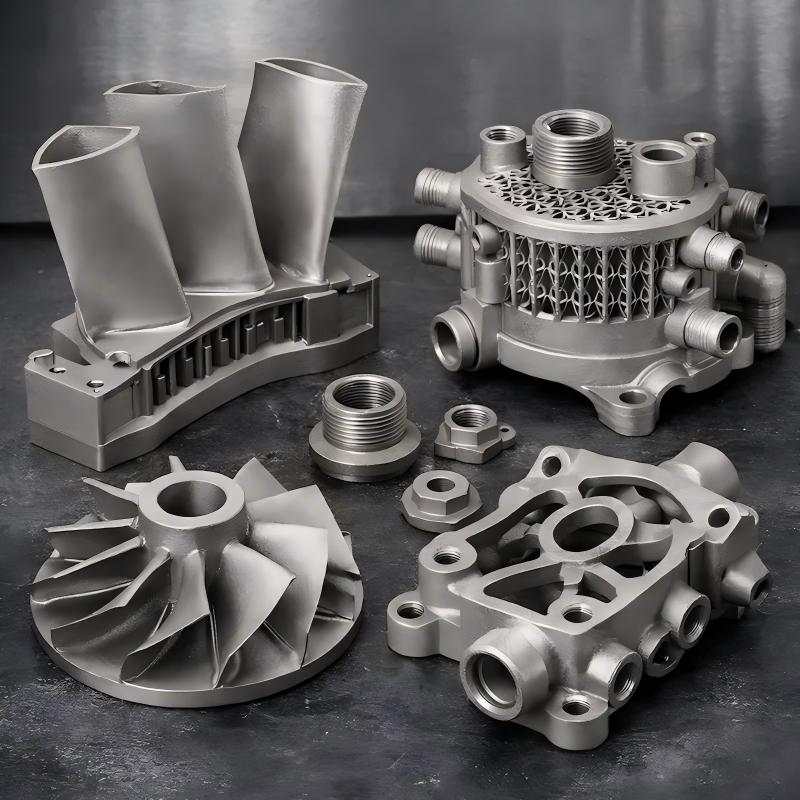
| Nickel-based superalloys represent a canonical material system for high-temperature/thermal resistance applications in metal additive manufacturing, ideally suited for scenarios demanding sustained structural integrity and reliability under elevated temperature conditions. When components necessitate intricate internal channels, monolithic fabrication, localized thin-wall features, and structural integration—particularly when post-processing steps such as sandblasting and threading can finalize assembly interfaces—Selective Laser Melting (SLM) technology significantly abbreviates the development lifecycle. |
Key parameters and order requirements
| Prior to placing an order, please confirm the following: ① Is the component intended for prolonged high-temperature service conditions (specify temperature/duration/medium) and does it require heat treatment (affects performance specifications and delivery schedule)? ② Are there sealing surfaces/mating interfaces/datum features present (recommend specifying tolerances and reserving finish machining allowances)? ③ Do internal cavities/flow channels require powder removal (note outlet dimensions, bend radii, and cleaning access openings)? ④ Is threaded assembly required (clarify thread specifications, quantity of holes, and tapping requirements)? These parameters represent commonly referenced ranges and are subject to variation depending on forming conditions, build orientation, heat treatment, and subsequent finishing processes. Should you require performance data aligned with specific material grades or standards, please consult our engineering team for verification.. |
| Technology | Selective Laser Melting (SLM) Metal Additive Manufacturing (Nickel-Based Superalloy) |
| Material system | Nickel-based superalloy (prioritized for high-temperature operating conditions; suitable for integrated molding of complex structures) |
| Dimensional tolerance | ±0.10 mm (commonly used as a reference; it is recommended to specify tolerance for critical mating surfaces and reserve finishing allowance) |
| Minimum wall thickness | ≥ 0.5mm (Reinforcement and optimized placement are recommended for thin-walled or long cantilever structures to mitigate deformation and cracking risks.) |
| Minimum Aperture/Diameter | It is recommended that the dimension be no less than 2.0–3.0 mm (powder removal must be evaluated for deep holes/internal cavities; for assembly holes, allowance is advised prior to tapping/reaming) |
| Layer thickness | A layer thickness of 0.03–0.06 mm is typically employed (dependent on equipment specifications and parameter settings; thinner layers generally enhance resolution but incur higher costs) |
| Temperature resistance | 650°C (for high-temperature operating conditions, please specify the maximum temperature, duration, and operating medium) |
| Tensile strength | 900–1300 MPa (dependent on heat treatment conditions and build orientation) |
| Density | 8.2 g/cm³ |
| Surface roughness | The formed surface exhibits relative coarseness; sandblasting may enhance the aesthetic quality and tactile properties, while precision finishing is recommended for sealing/mating interfaces |
| Heat Treatment/Performance Caliber | Heat treatment and stress relief procedures can be assessed according to operational conditions; to align with standard grade specifications, please specify requirements in the remarks |
| Assembly and Threading Technology | Thread cutting operations are supported; please specify thread specifications (e.g., M3/M4/M5, etc.), quantities, and positions. For key assembly holes, it is recommended to provide 2D annotations and mating requirements |
| postprocessing | Sandblasting, CNC machining (thread tapping), painting, polishing, electroplating, passivation, anodizing, laser engraving, screen printing |
| delivery time | The delivery schedule, including options for expedited processing, is determined upon file submission and depends on factors such as dimensions, quantity, placement, and the requirement for heat treatment or post-processing |
postprocessing
| Sandblasting (for appearance and texture improvement) | Tapping Process (Assembly Interface) |
| This process is employed to reduce surface roughness and minimize powder sintering marks in metal-printed components, thereby achieving a more uniform matte finish. It offers enhanced compatibility with non-sealed exterior surfaces. | Applicable for screw connection and assembly verification. Please specify the thread specifications, quantity of mounting holes, and key hole fit requirements in the remarks; for high-temperature operating conditions, it is recommended to clarify the assembly method and load direction. |
Why choose nickel-based superalloy (SLM)
| Enhanced stability under high-temperature operating conditions | Integrated Monolithic Structures for Complex Systems | Strength and Dimensional Control | Direct Assembly After Post-Processing |
| To address the requirements for thermal-environment applications and high-temperature functional validation, structural integrity and reliability are more effectively maintained under elevated temperatures | Suitable for complex internal flow channels, topology-optimized and integrated structures, minimizing welding/assembly requirements and shortening iteration cycles | Through optimization of placement, heat treatment, and critical surface finishing, more controllable assembly accuracy and strength specifications can be achieved | The process supports rapid assembly validation through sandblasting and tapping operations; critical hole locations can be enhanced with secondary machining strategies to improve dimensional consistency |
More suitable (recommended) | Direct application is not recommended (process/material alteration advised) |
|
|
Design and DFM Recommendations
Reserve allowance for finish machining on key surfaces: It is recommended to reserve machining allowance for the sealing surface / mating surface / positioning datum, and clearly indicate the tolerance and datum system in the 2D drawing. |
Thin-walled and thermal deformation control: For thin-walled (close to the minimum wall thickness) and long cantilever structures, it is recommended to add stiffeners, make fillet transitions, and reduce thermal stress concentration by proper placement. |
Clearing and removing powder from the inner cavity / inner flow channel: Provide an outlet and path for the removal of impurities, avoiding the formation of a "closed cavity + narrow channel"; when necessary, add cleaning windows or split the structure. |
| Hole Positioning and Thread Strategy: It is recommended that the assembly holes be "printed with allowance + secondary processing/threading". Please clearly specify the thread specifications and the number of holes. For critical holes, it is suggested to provide 2D annotations. |
Support and surface requirements: The appearance surfaces and key surfaces should avoid contact with supports as much as possible. For appearance consistency, sandblasting can be used to unify the texture, but it is still recommended to perform fine processing on key surfaces. |
Compared with common metal 3D printing materials
| materials | core advantage | Mainly applicable | Not Applicable |
| Stainless Steel 316L (SLM) | Enhanced corrosion resistance, suitable for application in humid/saline environments and compatibility with general metal terminal components | Corrosion-Resistant Functional Components, End Parts, and Complex Structural Components | For projects where lightweight design and thermal conductivity are the primary objectives (AlSi10Mg is more suitable) |
Aluminum alloy AlSi10Mg (SLM) | Enhanced lightweight design, ideal for integrated molding of thermal dissipation/conductivity and complex structures | Heat Sinks, Lightweight Supports/Brackets, and Complex-Flow-Channel Metallic Components | Scenario Prioritizing High Corrosion Resistance (316L Offers Superior Stability) |
Titanium alloy TC4 (SLM) | High strength-to-weight ratio, performance first | High-end structural components, lightweight terminal parts, reliability-prioritized parts | Budget-sensitive general lightweight / heat dissipation parts (AlSi10Mg is more economical) |
Tool steel 1.2709 (SLM) | High strength and good heat treatment performance, suitable for fixtures/molds | Jigs and fixtures, mold inserts, high-strength structural parts | High corrosion resistance is required (316L is more suitable) |